
Multi Technology
Turning Dredged Harbour Sediment Into a Reusable Resource
Environmental Technology · Ports & Maritime Infrastructure
Looking Ahead
Environmental Technology · Ports & Maritime Infrastructure
Environmental Technology · Ports & Maritime Infrastructure
Marine sediment management in brief
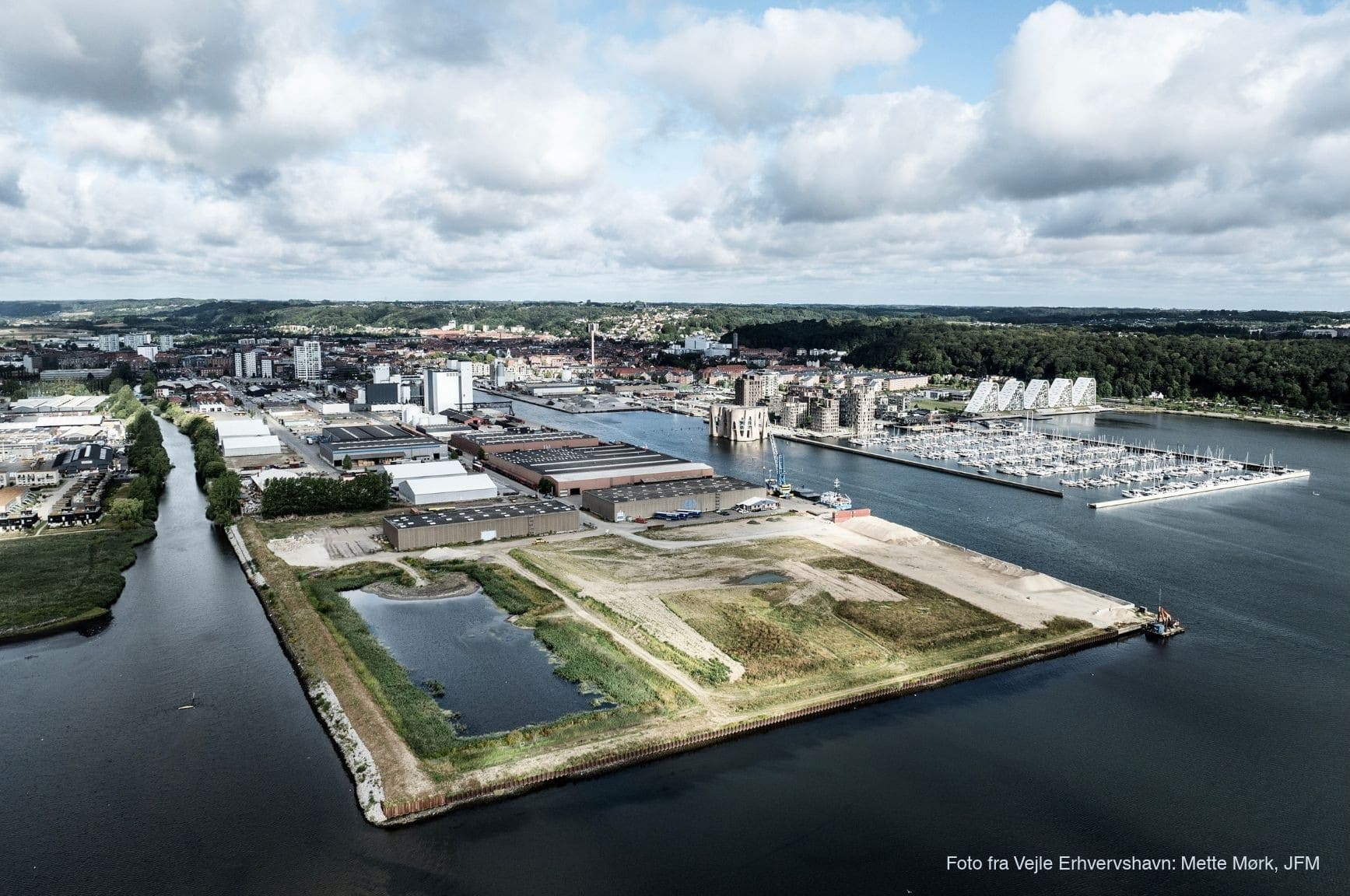
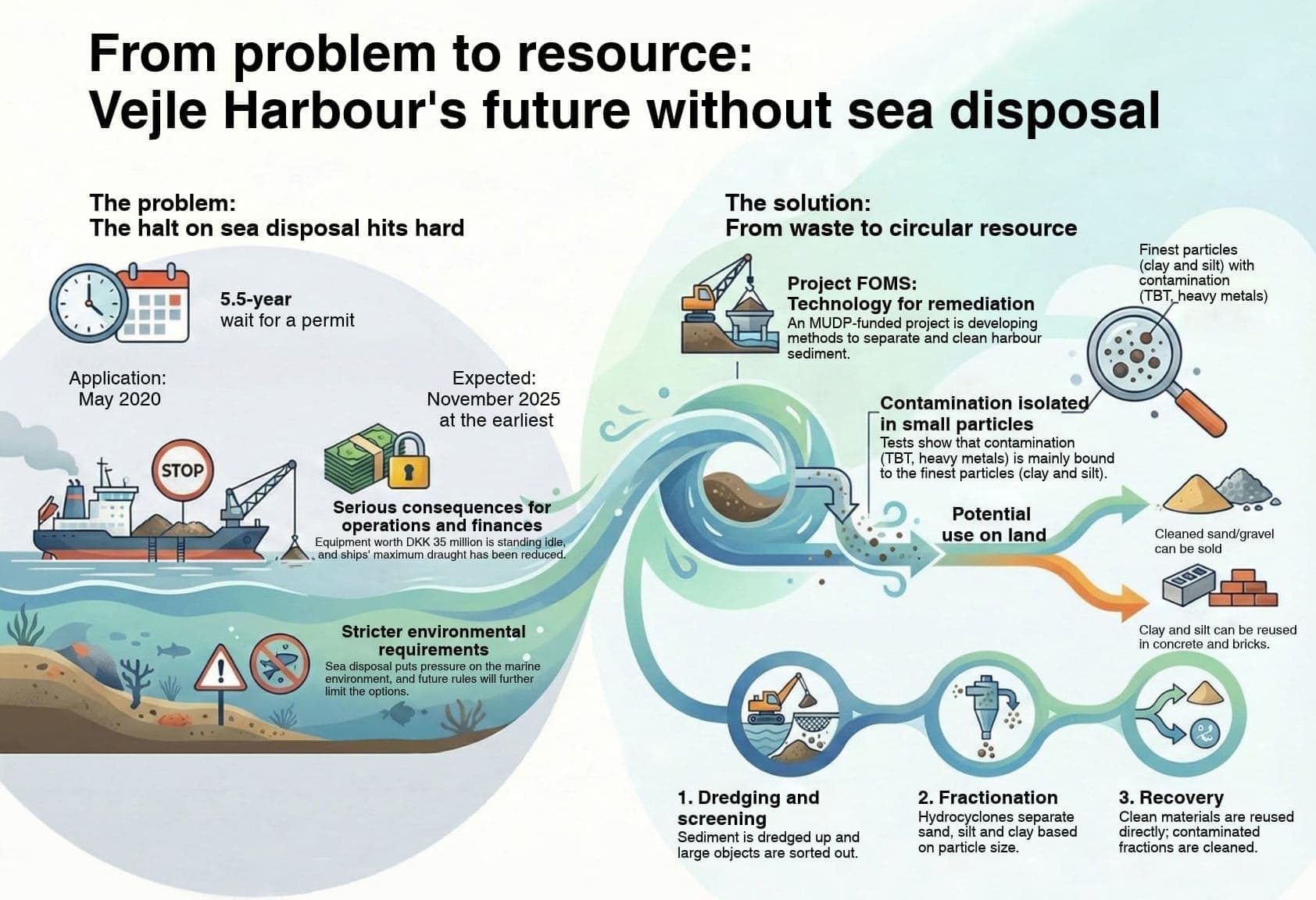
Danish ports must regularly dredge sediment to keep harbour basins and sailing channels navigable – a routine but unavoidable task. The problem is that some of this sediment carries heavy metals and other legacy pollution, and the traditional response, dumping it at sea under permit ("klapning") or sending it to landfill, is becoming harder to rely on. Environmental thresholds for sea disposal are tightening, and approval timelines have stretched to years rather than months; in this project, one partner port waited more than five years for a decision on a single application. For an activity ports cannot simply stop doing, that is a growing operational and financial risk. Yet historically, there has been no proven, affordable way to tell which parts of a dredged load are genuinely contaminated and which are not – so entire volumes tend to be managed, and paid for, as if they were all equally a problem.
A Fractionation-Based Approach to Clean Sediment
The starting hypothesis was simple: heavy metals and other contaminants in marine sediment do not distribute evenly – they bind disproportionately to the finest particles, silt and clay. If sediment can be reliably split by particle size, the cleaner, coarser fractions (sand, gravel) could be isolated and reused, while treatment and disposal effort is concentrated on a much smaller volume of genuinely contaminated fines. Working with Vejle Erhvervshavn and Aarhus Havn, and backed by Denmark's MUDP (Danish Eco-Innovation Program) environmental technology programme, IPU set out to test that hypothesis against real sediment from both harbours, not just literature and lab theory.
IPU's Engineering Approach
The project combined sediment sampling and chemical analysis from both harbours, lab- and pilot-scale process trials, and a comparative economic study across three plant concepts – land-based, a ship-and-land hybrid, and a fully ship-based mobile unit. Throughout, the approach stayed close to what a real harbour could operate day to day: proven, commercially available equipment rather than bespoke lab apparatus, and a deliberate focus on reporting what worked as clearly as what didn't.
Separating Clean from Contaminated – hydrocyclones consistently separated sediment into three fractions; the finest fraction reliably carried the highest concentrations of heavy metals, TBT and phosphorus, while sand and gravel came back markedly cleaner.
Clarifying and Dewatering the Process Water – coagulation/flocculation with ferric chloride plus a lamella clarifier achieved 99.7% clarification; a centrifuge reduced water content of the finest fraction by ~85%.
Looking Ahead
Looking Ahead: From Pilot Data to Full-Scale Facility
The economics back up the technical case. Compared with a conventional dredge-and-landfill reference scenario (≈739 DKK/tonne over 10 years), all three treatment concepts came in 26–33% cheaper (494–544 DKK/tonne) – an estimated 35–44 million DKK a year in savings at 180,000 tonnes of sediment annually. Roughly 40% of dredged material looks safely reusable today, with a further ~30% potentially reusable pending more documentation and regulatory sign-off. Citric acid cleaning worked only partially (30–40% metal reduction) – a clear signpost for where R&D still needs to go, not a finished solution. At a close-out meeting in Vejle in June 2026, Denmark's Ministry of Environment, the Environmental Protection Agency, Vejle Municipality and the Danish Ports Association all confirmed strong interest in moving this toward a pilot-scale facility – potentially one mobile enough to serve several harbours rather than just one.
Why IPU
Projects like this are exactly where we feel that we work best at IPU: at the intersection of environmental science, process engineering and hard-nosed business casing, applied to a problem that a client can't simply out-source to a single vendor. Rather than proposing a single piece of equipment, IPU builds and tests the full chain, from sediment characterisation to plant economics, so that ports, regulators and industry partners are working from the same evidence when they decide what to build next.
Client: Vejle Erhvervshavn, Aarhus Havn
Sector: Ports & maritime infrastructure
Programme: MUDP (Danish Ministry of Environment)
Duration: 32 months