
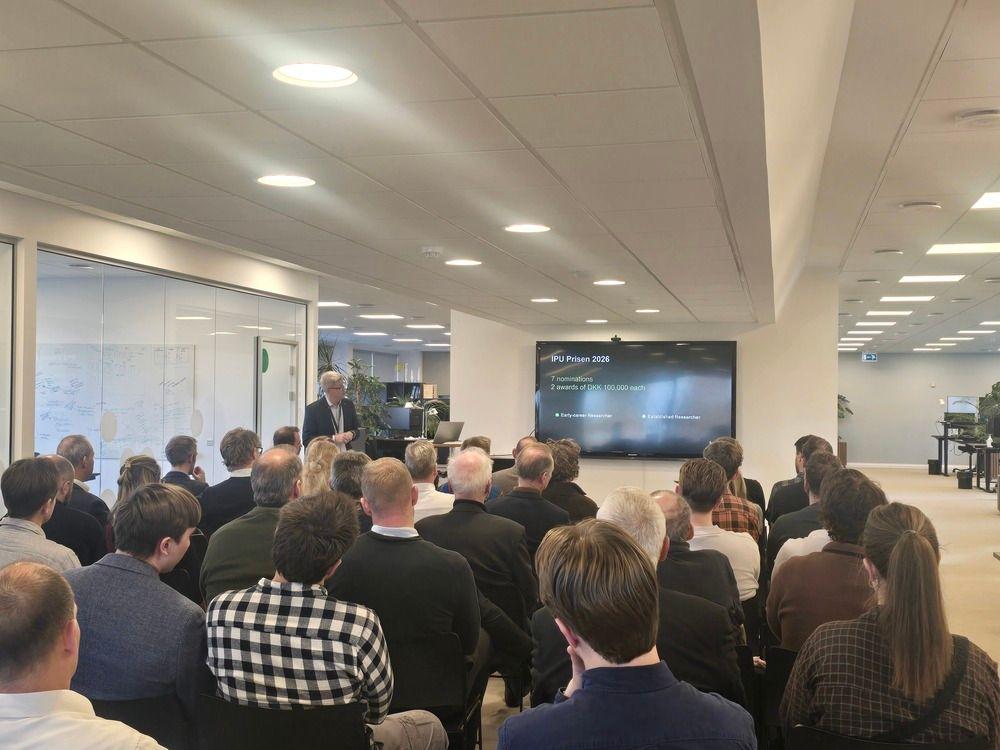
IPU Prisen 2026
IPU Prisen 2026: Two researchers proving what automation can do for Danish industry
On 6 November 2026, IPU Fonden awarded IPU Prisen 2026 to two researchers whose work makes a difference in Danish industry. Read about the winners below and download their presentations from the Award Ceremony.
About IPU Prisen 2026
IPU Prisen 2026 awards DKK 200,000 to automation research that makes a difference in Danish industry. For the first time, the prize was given in two categories, each worth DKK 100,000:
- Early-career researcher
- Senior researcher
This year’s theme
This year’s theme was Automation as a driver for innovation and industrial collaboration. It reflects a challenge many Danish companies know well: automation only creates value when research and industry work together.
Nominations and selection
Eight Danish universities each nominated two candidates, 16 in total. The winners were selected by the IPU Fonden board, which brings together extensive experience from industry and research:
Hans Nørgaard Hansen, Tina Moe, Christian Jørgensen, Klaus Schütt Hansen and Daniel Minzari.
Early-career researcher: Researcher Nicholas Hansen, DTU Electro
Intelligent decision-making
The hardest part of autonomy isn’t getting a machine to make a decision. It’s proving that it will make the right one.
Nicholas turns human rules and good practice into logic that an autonomous system can follow, check and explain.
At sea, he helped turn the collision regulations into an autonomous decision system for the Danish company SenseMakers. That work supported the approval of the company’s autonomous navigation.
Senior researcher: Professor Christian Schlette, SDU
Intelligent execution
Christian makes automation pay off for small series and products that change from order to order.
Robotic operations are planned, programmed and tested in a digital twin, straight from the design data.
As head of SDU Center for Large Structure Production (LSP), he runs one of the world’s largest robot workspaces. He also coordinates the national project “LSP Ship Factory” with five Danish shipyards.
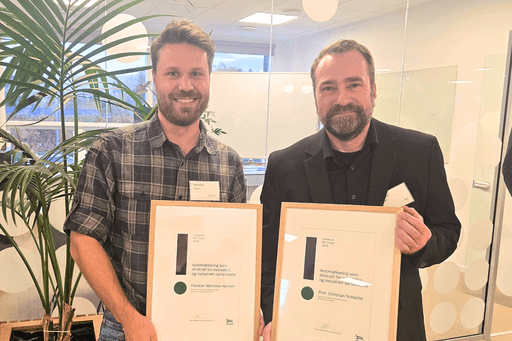
From left to right:
Researcher Nicholas Hansen, DTU Electro
Professor Christian Schlette, SDU
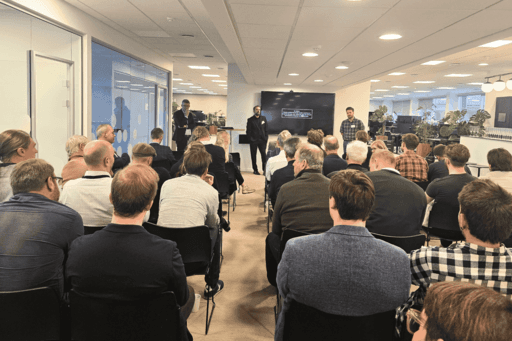
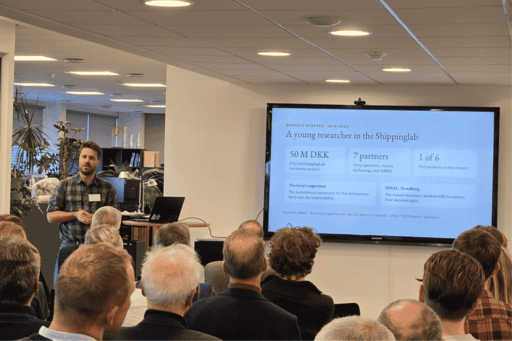
Takeaways from the afternoon
Takeaways from the afternoon
DECIDING · Researcher Nicholas Hansen, DTU Electro
→ “It depends” is not vague. It’s precise.
A navigator always puts safety before efficiency, and every decision weighs position, traffic, conditions and what other captains are likely to do. By observing captains in simulator sessions, Nicholas turned that intuition into a decision model. The autonomy stack mirrors a crew – navigator, chief engineer and captain as separate systems – which made a complex system easier to understand.
→ Uncertainty can be measured.
A ship never knows exactly where other vessels are heading. So “Is there a risk?” stops being yes or no and becomes a probability, calculated from speed, course and closest point of approach.
→ Simplify the problem before you automate it.
Understand what is hard for a machine, and find robust, simple solutions for safety-critical tasks. This approach helped the Danish company SenseMakers bring autonomous water-quality monitoring to market as a commercial service.
EXECUTING · Professor Christian Schlette, SDU
→ Heavy industry holds the next productivity leap.
These structures are still largely built by hand, often without sufficiently precise 3D models a robot could work from. A McKinsey study from 2017 estimated potential productivity gains of up to 60–80% for this sector. Christian’s point: build on what we already have.
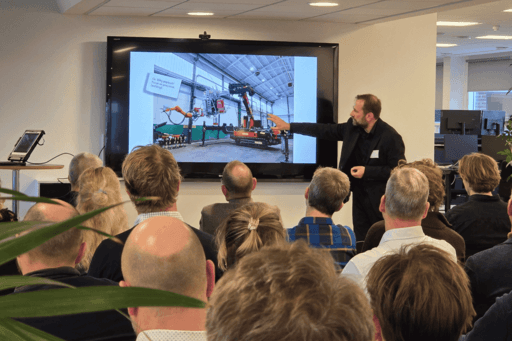
One example: instead of building a dedicated robot, Christian’s team mounted a standard industrial robot on a mobile crane. The crane gives a reach of 15–20 metres, the robot arm adds the precision, and sensors at the tip compensate for sway in real time.
→ Humanoid robots won’t be welding ships in five years.
Physical realities, unpredictable environments, structural vibration and tight tolerances make humanoids impractical for heavy industrial tasks in the near term. Progress over the next five years will come from breaking the solution down into realistic steps: precise control that compensates for inertia and vibration, correct detection of the work area, and automated quality assessment and documentation. With people working close to the machines, safety remains one of the biggest bottlenecks.
→ Technologies may be outdated in months, so the development process must be flexible.
Get things up and running to test and gain knowledge. Test facilities – large-scale or custom-made – provide that flexibility, and combining what you learn there with the people who know the science is how challenges get solved.